Foundation Repair in Wichita, KS
Most people expect foundation trouble after heavy rain. In south-central Kansas it more often arrives after a dry August - and knowing that changes both what you look for and what you can do about it.
In Wichita, steel push piers run $1,300-2,100 installed, and a typical job needs six to fourteen of them. Crack injection on a poured wall is $450-1,400. An independent structural engineer's report is $400-900.
Kansas does not license foundation repair contractors at state level. There is no state board to check a licence against, which puts more weight on the engineer's report and on references than in states that do license.
The clay here shrinks in drought and swells when it rewets. That means the destructive movement is usually late summer, not spring - and it means evenly watering the soil around your foundation during a dry spell is a real, cheap preventive step.
Why drought is the enemy here
Expansive clay changes volume with moisture. Wet, it swells; dry, it shrinks and pulls away from whatever is resting on it. In a climate with reliable rainfall the soil stays roughly stable and nothing much happens. South-central Kansas does not have reliable rainfall - it has wet years and hard dry summers.
During a dry spell the clay under the perimeter of your house shrinks first, because the edges dry faster than the middle. The footing loses support around the outside while the centre stays put. The house responds by cracking - typically at the corners of door and window openings, on the diagonal, because that is where the stress concentrates.
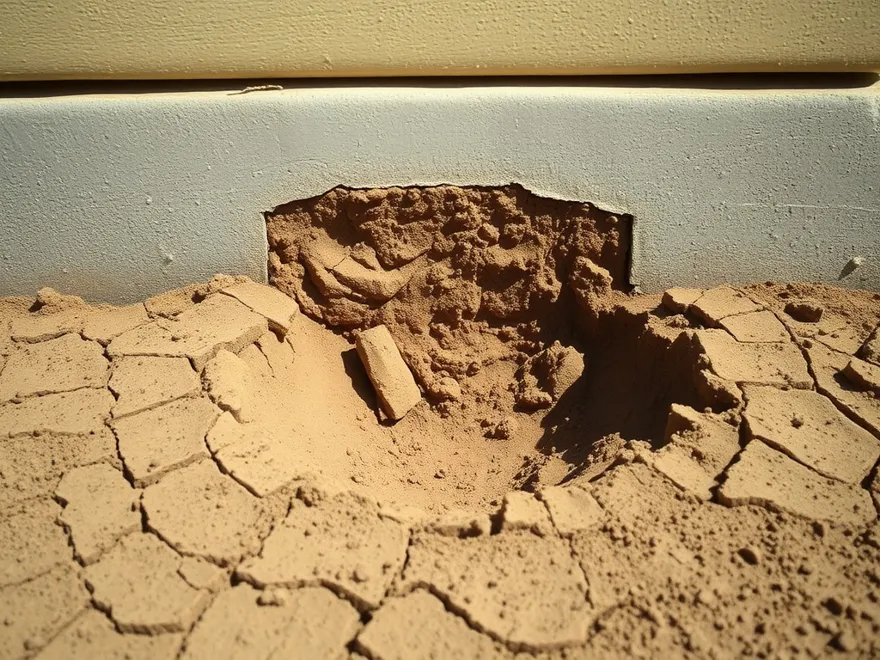
The gap you can see with your own eyes
Walk the perimeter of your house at the end of a dry August. If you can see a gap between the soil and the foundation wall - sometimes wide enough to drop a coin into - that is the mechanism, visible and unambiguous. The soil has shrunk away and the footing is carrying less than it was designed to.
The cheap response is a soaker hose run around the perimeter, eighteen inches or so out from the wall, run slowly and evenly during dry spells. The goal is not to soak the ground - it is to stop the swing between bone-dry and saturated. Uneven watering is worse than none, because it moves one part of the house and not another.
This will not fix a house that has already settled. It is preventive, and for a house that has not moved much yet it is the single highest-value thing a Wichita homeowner can do.
What the warning signs actually mean
| What you see | Usually means | Urgency |
|---|---|---|
| Hairline vertical crack in a poured wall | Concrete curing shrinkage | Low - very common, often cosmetic |
| Diagonal crack from a door or window corner | Differential settlement | Worth an engineer's opinion |
| Horizontal crack across a basement wall | Lateral soil pressure on the wall | Higher - this is a structural pattern |
| Doors sticking that did not before | The opening has racked out of square | Track it - note the date and the season |
| Gap between soil and footing in August | Clay shrinkage, the local mechanism | Act preventively now |
| Sloping floors, measurable with a level | Settlement over time | Engineer |
Seasonality matters when you judge severity. A door that sticks every August and frees up every spring is telling you the house is moving with the clay cycle. A door that stuck last August and never freed up is telling you something different.
Photograph cracks with a ruler or a coin beside them and write the date on the photo. Six months of that record is worth more to an engineer than any description you can give.
Why the engineer comes first here
In a state with no contractor licensing for this trade, the ordinary safeguards are thinner. A structural engineer who does not sell repairs has no interest in how many piers you buy. For a few hundred dollars you get a written opinion on whether the movement is active, what is causing it, and what - if anything - needs doing.
That report then does something else useful: it lets three contractors quote the same scope. Without it, you get three different diagnoses and three prices that cannot be compared, which is how people end up buying the most confident sales pitch rather than the right repair.
Common questions
Are all foundation cracks serious?
No, and most are not. Thin vertical cracks in poured concrete are usually shrinkage from curing and are extremely common. The patterns that warrant attention are diagonal cracks from opening corners, horizontal cracks, and any crack that is visibly wider at one end or that has grown since you first noticed it.
Push piers or helical piers?
Push piers are driven using the weight of the house and suit heavier structures with good load. Helical piers are screwed in and can be loaded immediately, which suits lighter structures and poor soil. Both are legitimate. If a contractor only ever installs one type, ask why it is right for your specific situation.
Is the lifetime warranty worth anything?
It is worth exactly as much as the company behind it. Ask how long they have traded under that name, whether the warranty is transferable when you sell, and what specifically it excludes - most exclude any movement in areas not piered, which can be most of the house.
Will insurance cover it?
Almost never. Standard homeowners policies exclude earth movement, settling and soil expansion. The exception is settlement caused by a covered event, such as a plumbing leak washing out soil under the footing. If you suspect a leak is involved, say so early - that changes the claim entirely.
Should I fix it before selling?
Kansas requires sellers to disclose known material defects. An engineer's report plus a completed repair with a transferable warranty is generally an easier sale than an unexplained crack, because buyers price uncertainty higher than they price a known, fixed problem.
- Wichita
- Derby
- Andover
- Haysville
- Park City
- Bel Aire
- Goddard
- Maize
Get written quotes from a Wichita contractor
Tell us what you are seeing, roughly when it started, and whether it changes with the season. That last detail tells a good contractor more than a photograph does. One local company, written quote, no charge, no obligation.
Or call (877) 701-2518
Prices in other cities
Abilene · Akron · Allentown · Amarillo · Ann Arbor · Appleton · Baton Rouge · Beaumont · Bloomington · Carrollton · Cedar Rapids · Champaign · Columbia · Coral Springs · Corpus Christi · Dayton · Denton · Des Moines · Durham · Eau Claire · Eugene · Evansville · Fargo · Fort Collins · Fort Lauderdale · Fort Wayne · Gainesville · Garden Grove · Grand Rapids · Green Bay · Hampton · Harrisburg · Hartford · Hayward · High Point · Joliet · Kansas City · Killeen · Lafayette · Lake Charles · Lakewood · Lansing · Lehigh Acres · Lewisville · Lincoln · Lubbock · Manchester · Meridian · Midland · Miramar · Mobile · Modesto · Naperville · New Haven · Norfolk · Ocala · Ogden · Olathe · Oshkosh · Palm Bay · Palmdale · Pasadena · Paterson · Pearland · Pembroke Pines · Peoria · Port St. Lucie · Providence · Provo · Pueblo · Reno · Roanoke · Rochester · Rockford · Round Rock · Salinas · Santa Clara · Santa Rosa · Savannah · Shreveport · Sioux City · Sioux Falls · Spokane · Springfield · Stamford · Sterling Heights · Sunnyvale · Syracuse · Tallahassee · Tempe · Thornton · Toledo · Topeka · Utica · Warren · Waterloo · West Valley City · Wilmington · Worcester · Yakima · Youngstown