Foundation repair in Kissimmee, and what the ground here actually does
Soil sampled near Kissimmee runs 3 percent clay with a linear extensibility of 1.5, which is the standard measure of how much that ground changes volume with moisture.
National pier range: $1,100-2,900 installed
National job range: $400-28,000
Soil near Kissimmee: Myakka
Shrink-swell (lep): 1.5
Free written quotes, one local company
Soil sampled near Kissimmee runs 3 percent clay with a linear extensibility of 1.5, which is the standard measure of how much that ground changes volume with moisture.
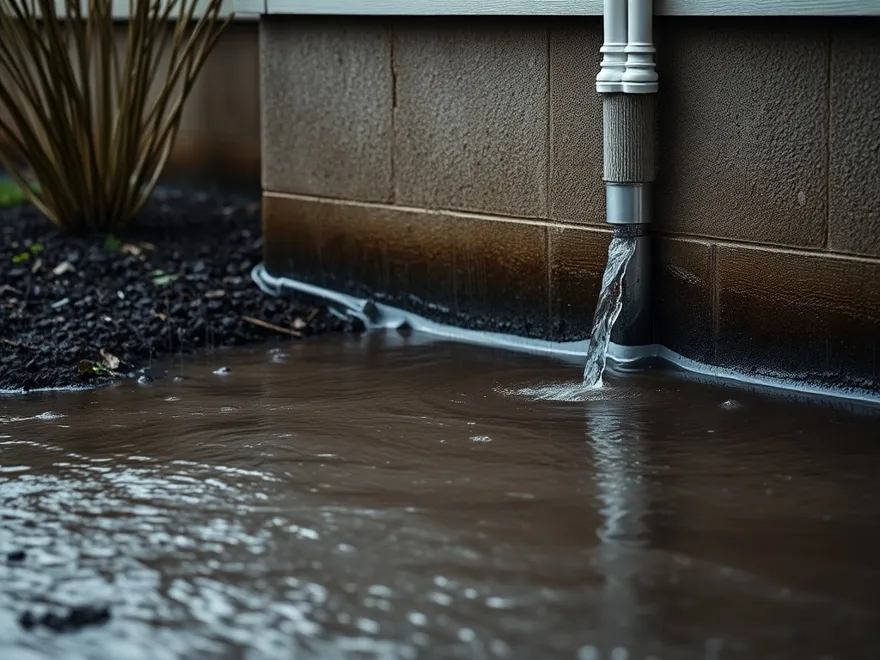
Water against the wall in Kissimmee
soil drainage here is rated Poorly drained.
That is the mechanism behind most of the movement reported around Kissimmee. It matters because the fix follows the cause: soil that moves with moisture is a different job from a footing that was never deep enough.
What the ground under Kissimmee actually does
The median home in Kissimmee was built in 1992, which sets what the footing is likely to be and how deep it sits.
Kissimmee averages 1706 mm of rain a year, and it is the swing between the wet and dry parts of that total, not the total itself, that moves a footing.
What foundation work costs
National ranges, 2026
| Work | Typical installed cost | What decides it |
|---|---|---|
| Crack injection, one crack | $400-900 | Poured walls only |
| Push pier, per pier | $1,100-2,900 | Depth to load-bearing soil |
| Helical pier, per pier | $1,400-3,200 | Used where soil is soft deep down |
| Slab lift (polyurethane) | $800-2,600 | Area and lift required |
| Full stabilisation | $8,000-28,000 | Pier count from the engineer's report |
These are national ranges. We have not yet collected enough quotes in Kissimmee to publish a defensible local range, and we would rather say so than invent one.
With a median home value around $304,400 in Kissimmee, foundation work sits at a meaningful fraction of the asset, which is why getting more than one opinion pays.
Permits pulled through: Osceola County
Median home in Kissimmee built: 1992
Detached single-family houses: 46%
Water hardness: 46 mg/L (soft)
Dominant soil series: Myakka
Clay content: 3%
Shrink-swell (LEP): 1.5 - low
Annual rainfall: 67 inches
This ground is classified as poorly drained
The soil survey classifies the ground around Kissimmee as Poorly drained. Poorly drained soil keeps water against the footing long after the rain has stopped, which is a different problem from a wet basement - it is a bearing problem. Saturated soil carries less weight than the same soil dry. **Ask a bidder whether their fix addresses bearing or just water**, because a drain system alone does not restore a footing that has already settled into softened ground.
67 inches of rain a year has to go somewhere
Kissimmee takes roughly 67 inches of rain a year. Most foundation problems that get blamed on soil are really drainage problems: gutters discharging next to the wall, grade sloping back toward the house, a downspout buried into a line that stopped working years ago. **The cheapest honest quote you can get is the one that fixes the water first and re-measures next season.** If a company inspects your foundation without walking your downspouts and your grade, they have skipped the step that decides whether the expensive work is needed at all.
Who pulls the permit - and whose name is on it
Work in Kissimmee is permitted through Osceola County. Two questions decide whether a quote is honest: **does the price include pulling the permit, and will the company pull it in its own name?** A contractor who asks you to pull it as the homeowner is moving liability onto you - if the inspection fails, it is your permit that failed. Ask for the licence number the permit will be filed under, then check it against the state licence board before you sign anything.
Questions homeowners in Kissimmee ask
Are the cracks in my wall serious?
Most are not. Thin vertical cracks in poured concrete are usually curing shrinkage and extremely common. The patterns worth attention are diagonal cracks running from the corner of a door or window, horizontal cracks in a block wall, and any crack that is wider at one end than the other. Mark the ends with a pencil and a date - if it moves over a season, that is the information an engineer actually wants.
Do I need an engineer before I get quotes?
For anything beyond a single crack, yes, and it is the best few hundred dollars in this whole process. A structural engineer has no product to sell, so the pier count in their report is the number to quote against. Without it you are comparing quotes where each company decided for itself how much work is needed.
Why do quotes differ so much for the same house?
Usually because they are proposing different pier counts or different pier types. Ask each company to price against the same engineer's report and most of the spread disappears. What is left is access, excavation depth and whether concrete has to be removed and replaced.
Will this get worse if I wait?
It depends entirely on whether the cause is still active. Movement that finished settling years ago can sit unchanged indefinitely. Movement driven by seasonal moisture keeps going, because the cause comes back every year. That is why the monitoring answer above matters more than the crack width today.
- Kissimmee
Get written quotes in Kissimmee
Tell us what you are seeing, where in the house, and whether it changes with the season. That last detail tells a good contractor more than a photograph does. We pass it to one independent local company. No cost, and we do not sell your details on.
Or call (877) 701-2518
Prices in nearby cities
Clearwater · Coral Springs · Davie · Daytona Beach · Deerfield Beach · Fort Lauderdale · Gainesville · Lauderhill · Lehigh Acres · Miramar · Ocala · Palm Bay