Foundation repair in Dearborn, and what the ground here actually does
Soil sampled near Dearborn runs 17 percent clay with a linear extensibility of 1.0, which is the standard measure of how much that ground changes volume with moisture.
National pier range: $1,100-2,900 installed
National job range: $400-28,000
Soil near Dearborn: Riverfront
Shrink-swell (lep): 1.0
Free written quotes, one local company
Soil sampled near Dearborn runs 17 percent clay with a linear extensibility of 1.0, which is the standard measure of how much that ground changes volume with moisture.
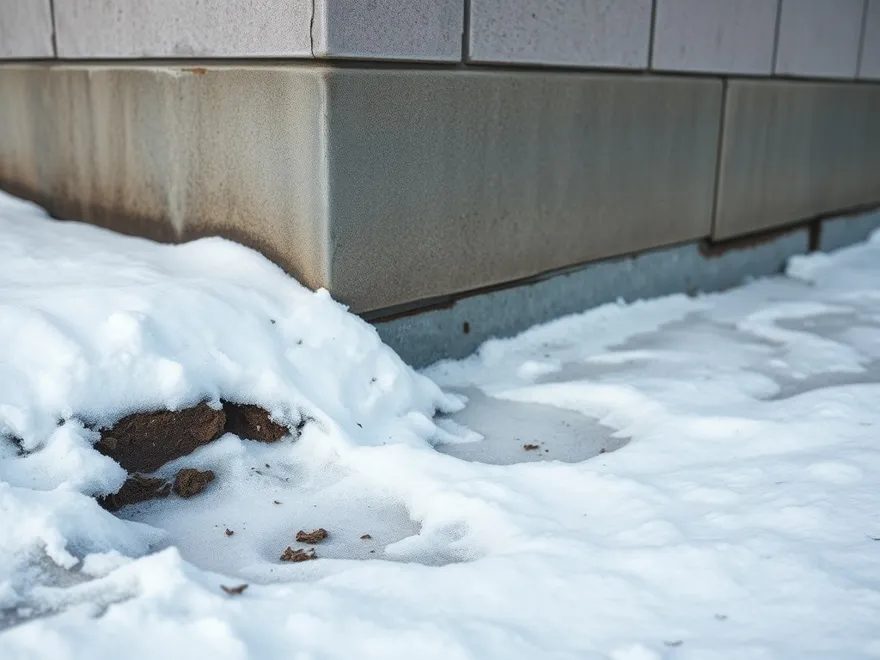
Frost heave in Dearborn
一年 85 天日夜跨越冰點.
That is the mechanism behind most of the movement reported around Dearborn. It matters because the fix follows the cause: soil that moves with moisture is a different job from a footing that was never deep enough.
What the ground under Dearborn actually does
Dearborn records about 85 days a year where the temperature crosses freezing between night and day, and each of those cycles works existing cracks a little wider.
The median home in Dearborn was built in 1952, which sets what the footing is likely to be and how deep it sits.
What foundation work costs
National ranges, 2026
| Work | Typical installed cost | What decides it |
|---|---|---|
| Crack injection, one crack | $400-900 | Poured walls only |
| Push pier, per pier | $1,100-2,900 | Depth to load-bearing soil |
| Helical pier, per pier | $1,400-3,200 | Used where soil is soft deep down |
| Slab lift (polyurethane) | $800-2,600 | Area and lift required |
| Full stabilisation | $8,000-28,000 | Pier count from the engineer's report |
These are national ranges. We have not yet collected enough quotes in Dearborn to publish a defensible local range, and we would rather say so than invent one.
Dearborn averages 949 mm of rain a year, and it is the swing between the wet and dry parts of that total, not the total itself, that moves a footing.
Permits pulled through: Wayne County
Median home in Dearborn built: 1952
Detached single-family houses: 74%
Water hardness: 655 mg/L (very hard)
Dominant soil series: Riverfront
Clay content: 17%
Shrink-swell (LEP): 1.0 - low
Freeze-thaw cycles: 85 days a year
Hard freezes: 10 days a year
Annual rainfall: 37 inches
Annual snowfall: 26 inches
The median house here dates to 1952 - that dictates what is under it
The typical Dearborn home was built around 1952. Houses of that era were commonly founded on shallow footings poured without steel and, depending on the block, on rubble or unreinforced masonry stem walls. That changes the honest repair menu: **you cannot bracket a wall that has no steel in it the same way you bracket a modern one.** When a contractor quotes carbon fibre straps on a house of this age, ask what the wall is actually made of and how they confirmed it.
85 freeze-thaw days a year work on every crack you already have
Dearborn crosses the freezing point about 85 days a year. Every one of those days, water sitting in a crack expands as it turns to ice and widens the crack slightly. It is a slow additive process, which is why a hairline crack noted two winters ago is rarely still hairline. It also means **timing matters for the repair**: sealing a crack that is still moving simply re-cracks. Ask whether the company will monitor the crack across a season before sealing, and be suspicious of anyone who offers to seal it on the same visit as the inspection.
Who pulls the permit - and whose name is on it
Work in Dearborn is permitted through Wayne County. Two questions decide whether a quote is honest: **does the price include pulling the permit, and will the company pull it in its own name?** A contractor who asks you to pull it as the homeowner is moving liability onto you - if the inspection fails, it is your permit that failed. Ask for the licence number the permit will be filed under, then check it against the state licence board before you sign anything.
Questions homeowners in Dearborn ask
Are the cracks in my wall serious?
Most are not. Thin vertical cracks in poured concrete are usually curing shrinkage and extremely common. The patterns worth attention are diagonal cracks running from the corner of a door or window, horizontal cracks in a block wall, and any crack that is wider at one end than the other. Mark the ends with a pencil and a date - if it moves over a season, that is the information an engineer actually wants.
Do I need an engineer before I get quotes?
For anything beyond a single crack, yes, and it is the best few hundred dollars in this whole process. A structural engineer has no product to sell, so the pier count in their report is the number to quote against. Without it you are comparing quotes where each company decided for itself how much work is needed.
Why do quotes differ so much for the same house?
Usually because they are proposing different pier counts or different pier types. Ask each company to price against the same engineer's report and most of the spread disappears. What is left is access, excavation depth and whether concrete has to be removed and replaced.
Will this get worse if I wait?
It depends entirely on whether the cause is still active. Movement that finished settling years ago can sit unchanged indefinitely. Movement driven by seasonal moisture keeps going, because the cause comes back every year. That is why the monitoring answer above matters more than the crack width today.
- Dearborn
Get written quotes in Dearborn
Tell us what you are seeing, where in the house, and whether it changes with the season. That last detail tells a good contractor more than a photograph does. We pass it to one independent local company. No cost, and we do not sell your details on.
Or call (877) 701-2518
Prices in nearby cities
Ann Arbor · Flint · Grand Rapids · Lansing · Sterling Heights · Warren · Toledo · Mansfield · Akron · Fort Wayne · Youngstown · South Bend